
Improv writing games for the Daring,
the Adventurous,
the Edge-Livers!
Instant Stories
I lead the following game for second and third graders (7-9 year olds) and they always respond enthusiastically. In fact, it is what keeps me doing it. Everytime, I see it in their faces that they --get-- just how fun writing can be. Here's everything you need so you can do it too.
What you need:
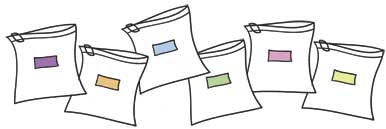
- 6 plastic bags, each one with a different label: Character, Event, Conflict, Place, Time, Unusual Object
- small slips of 6 different colored papers, one for each student
- Quick Wits
Each piece needs to be big enough for them to write a word or phrase on it. Sometimes I do multiple classes in series. Then I make sure I have one set of bags/paper for each class because I leave the bags with the class when I'm done so they can continue the game later.
In one half hour, I can get through creating two stories if I keep it moving. This is what it looks like when I do it.
Introduction - 10 seconds
I thank them for inviting me and I tell them I have a writing game to share with them. I ask them if they'd like to play. Of course, they're with me. At this point, I offer that we're going to build instant stories and that they'll see how it's done as we go.
Get the Words - 10 minutes
I pass out the first color (any color) and ask them to write down a character, any character, on this piece of paper. Usually, they're not sure what a character is exactly or just how far I'm willing to go. I spend a short bit discussing what Character means by giving examples and answering their questions. I do this while I'm asking them to write down a character. I encourage them to not try to be sensational and that it works better if they just keep it simple and use the first character that pops into their head. I play this part pretty loose - I'll accept a clown face drawn on the sidewalk as a character. It really doesn't matter. You'll see in the end.
I give them 20-30 seconds to fill it out. If some are having trouble, I tell them not to worry and we move onto the next word. I'll have more than enough characters to finish the half hour.
Collect them in the bag. I try to move pretty fast so we can get to the more fun part. I don't tend to ask for helpers at this point so that everyone can participate. I just have them pass their words to the front and I collect them while moving onto the next word.
Go through the process for the next word, Event. Do for each of the rest of the word types - Place, Time, Conflict, Unusual Object.
Often there is some confusion about Time vs. Place vs. Event. Again, I play it pretty loose. For example, I let turn of the century be a Time or an Event. As you'll see in the end, it really doesn't matter. Since so much of life is not black or white, I think it's good to let this lesson show up here.
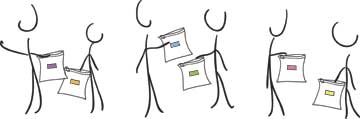
After doing all 6 words, I now have 6 bags full of their words of each type. Now, I ask for helpers. I only take those who volunteer themselves. If someone volunteers someone else, I mention, "if you volunteer someone else, you volunteer yourself." I'm never short on volunteers. I choose six. As they come up, I give them a bag and they stand in a row in the front of the class.
Build the Story - 5-10 minutes
Now comes the fast paced part. I usually line them up so that we do Character first. I ask the first student to pick a piece of paper out of their Character bag and read it to the class. For example, they pick "CEO". I say, "Ok, we have a story about a CEO. I wonder what that CEO is going to do."
I ask the next student. Let's say he has "Event". I ask him to draw one from his bag. He announces that he has drawn "pie eating contest". I say, "Ok, we have a CEO at a pie eating contest somehow. Maybe he eats the pies. Does he win or lose? Or maybe he runs the contest. Maybe something else. Let's see." A few students might mention their thoughts.
I move through the rest of the students, one by one, repeating each of the previous items along with the one the current student draws. The growth of excitement in the room is palpable and very fun. This is also when I start to forget what words have already been drawn. Then I just point to the student and ask them to repeat their word. When a new word is drawn, I go down all the previous words for extra charge. "So, we have a CEO who's at a pie eating contest, his nose is itchy, it's the Fourth of July on the moon and he has a bunch of parsley."
Once all six students have drawn words, we all brainstorm in a controlled chaos sort of way the different stories that would be possible with these 6 prompts. They can't help themselves but yell out their ideas. I personally like to encourage their energy but calm it just enough so we can all hear each other.
I can usually do a second pass through Build the Story in a half hour.
Variations:
- Add or interchange "Habit","Dream","Goal".
- Make up your own categories.
- For older students, use "Disaster", "Dilemma".
- Use 5 or 4 -- or 7 bags.
- If you have time, have them start writing their stories.
- Maybe a group of them share their stories over the weeks with each other.
- Teacher-pros I'm sure can fill in so much more here.
(Send me your suggestions and I'll post them.)
If you don't usually work with kids, I can almost guarantee that this would be a great way to start if you are excited about the idea. It worked for me. I'd say keep an open mind and keep moving with them. Take their suggestions and grow their ideas with them. I have to be on my toes a lot more than my regular job requires. I didn't have much experience with kids but their energy and enthusiasm carried me along, especially their faces that changed to pure excitement when they got it - just like lightbulbs turning on.
I was not fond of writing when I was their age. For some unknown reason, when I reached my late 30's, I gravitated to a writing class. Luckily I had an inspiring teacher and I've been hooked ever since.
Writing offers us so many avenues for personal pleasure and catharsis as well as communication of ideas through blogging and storytelling, to say nothing of journalism or better business relationships in any career. To see young people get this and not have to wait till their 30's, well, it's quite a kick.
This writing prompt style has appeared in many forms, including several variations for script writing. I've developed this format for application in the young student classroom. Feel free to use it for your own personal use to encourage young kids to feel the writing excitement.